Sunday, June 26, 2016

The Voices of the Dead and the Voices of the Living


The University of Amsterdam, it turns out, is pretty tricky to find for someone like me who had never been to Amsterdam before and has poor spatial and directional sense. Fortunately, I found a group of fellow conference attendees and together we managed to find our way through a tunnel and into a courtyard that led to the main building where the conference was being held. It was here I took a picture of the outer wall of the tunnel that houses the Oudemanhuispoort book stalls:


I took the picture because I liked the Banksy-style stencil art and the chance element of the weed growing in such a way that it looks like the woman is peering from behind it, as if hiding. But I'm also glad I included the engraved stone plaque on the wall:


If you can't read it on the picture, here are the words: "Toen is in mij het bewustzijn ontwaakt dat een van de taken van de historicus, de man die schrijft over de mensen van vroeger, is de doden stem te verlenen. De doden moeten kunnen spreken en als men hen het spreken belemmert dan sterven ze tweemaal. J.P."


I don't read or speak Dutch, nor did I realize who J.P. was until later when I did some research looking for the quotation. Before traveling to Amsterdam, I read Geert Mak's Amsterdam to get a sense of the history of the city. As one might imagine, the most harrowing part of the book was Mak's description of the treatment of the Jews in Amsterdam during the Nazi occupation, for which he relies heavily on the work of historian Jacques Presser. If you know this history and you know Presser, who was a professor at the University of Amsterdam, then you know that this is who J.P. is. Here is a more complete quotation from which the above quote comes, from Gesprekken met Jacques Presser (Conversations with Jacques Presser) by Philo Bregstein (quoted here in an article by Adriaan Venema):

“Ik lees het en voor mij heeft praktisch niemand het gelezen en na mij gaat de boel een archief in en zal er vermoedelijk geen haan ooit meer naar kraaien. Toen is in mij het bewustzijn ontwaakt dat een van de taken van de historicus, de man die schrijft over de mensen van vroeger, is de doden stem te verlenen. De doden moeten kunnen spreken en als men hen het spreken belemmert dan sterven ze tweemaal. Daar hoor ik zelf van op, dat klinkt rijkelijk aan de theatrale kant, ik kan er niets aan doen. Wie de doden het zwijgen oplegt, laat ze tweemaal sterven...”

These interviews with Jacques Presser have not been translated into English, as far as I know, but I found a translation of some of these words in the Afterword to materials for the film The Past That Lives, about Jacques Presser:

“When you have worked, as I have, for about fifteen years with these documents, you are continuously confronted with the dead, the voices of the deceased. I read these papers, the little scraps of paper, thrown from the train, the rare messages coming from Westerbork ... Before me, hardly anyone has read them and, after me, they are locked into the archives and it's possible that nobody else will see them. They awoke in me the awareness that one of the tasks of the historian, the man who writes about people in the past, is to give the dead a voice. The dead must be able to speak ... and anyone who lets the dead remain silent allows them to die twice, and I have simply refused to permit that.”  

In Amsterdam, Geert Mak quotes postwar testimony from a Holocaust survivor from Amsterdam: "The Netherlands has carried out the biggest public relations exercise to follow the Second World War by using the diary of Anne Frank to give the impression that the Jews were all in hiding here, and that the entire Dutch population was in the Resistance." Mak continues: "the Dutch still have a tendency to talk up the extent of their resistance to almost mythical proportions. In reality, proportionally more Jews were deported from the Netherlands than from any other Western European country."

The conference I was attending at the University of Amsterdam was Narrative 2016, the annual conference of the International Society for the Study of Narrative. I was there to deliver a paper on British-Nigerian writer Helen Oyeyemi’s 2009 novel White Is for Witching, which, to greatly simplify, is about a young girl named Miranda who, in order to grow up and live an independent life, must first escape the house she has lived in for much of her life, a house that, in Gothic tradition, has a will of its own—in this case, an isolationist, xenophobic, and racist will. The house’s xenophobia was born out of the reactionary fear of the enemy during and after the Second World War, a fear that inspired in the house a hostility toward outsiders and a desire to protect the family by sealing them off from others’ influence. The present day crisis of the novel comes when the house is opened as a bed-and-breakfast. Unwilling to offer hospitality to others, it drives them away. As the house states directly, “They shouldn’t be allowed in, those others, so eventually I make them leave.”

The house targets especially its non-white guests and staff, terrorizing the Azerbaijani family who work and live there, the new Nigerian housekeeper who is hired after they flee, and a black British couple who attempt to vacation there. When Miranda brings home her girlfriend Ore, whose mother was born in Nigeria, the house describes the relationship as “disgusting” and invades Ore’s mind with hallucinatory thoughts that her black skin is coming off on the towels after she takes a shower, while outside the bathroom door she hears voices singing “Rule Britannia!” Later she discovers her room covered in British National Party leaflets: “Do you know how many immigrants are in the UK? Neither does the UK government …

The novel is set in Dover during a crisis of stabbings of Kosovan refugees, stories of which appear regularly in The Dover Post. Meanwhile, the Nigerian housekeeper Sade visits the local Immigration Removal Center to visit with those there and bring them food. At one point, Sade returns home distraught because a young man at the Removal Center has hanged himself. She tells Miranda: “I’m thinking of the shame. To make a man hang himself. That place is a prison. You come without papers because you have been unable to prove that you are useful to anyone, and then when you arrive they put you in prison, and if you are unable to prove that you have suffered, they send you back. That place up there is a prison. He didn’t deserve that.”

But despite her relationship with Ore, despite her encounters with the sufferings of refugees, Miranda cannot escape the xenophobic influence of the house. One of the ways the house keeps its hold on her is through an eating disorder called pica, passed down through the women of the family who have grown up in the house. Pica, as the novel tells us, “is an appetite for non-food items, things that don’t nourish.” For Miranda, this means eating bits of plastic and, significantly in terms of the novel’s symbolism, chalk. For this is Dover of the famous white chalk cliffs and the famous Vera Lynn song that, in the same year the novel was published, was being used by the BNP to promote their white nationalist ideology. Throughout the novel Miranda eats white chalk, as if ingesting the house’s xenophobia. Ultimately, the house and its ideology devour her: she remains trapped in a wall of the house, eating (white) plaster.

The day after I returned to the U.S. from Amsterdam was World Refugee Day, the day the UNHCR released its annual report, which stated "65.3 million people, or one person in 113, were displaced from their homes by conflict and persecution in 2015," the largest number since UNHCR has been keeping records.

A few days later, the UK voted to exit the EU, a vote inflamed by anti-immigrant rhetoric.

Miranda’s fate in Oyeyemi’s novel—the home of the isolated self intertwined with the home of the isolationist nation as they feed on each other—may very well be the fate of England after Brexit: police the borders, determine who belongs, exclude those who are deemed outsiders, and eat itself to death. This might be fine if it didn’t have real consequences for those excluded others.

While one narrative of Brexit focuses on working-class antagonism toward elites, this narrative obscures the way the Leave campaign relentlessly used the language of “taking our country back” and a suspicion of “open borders” to draw on anti-immigrant fears. And recent reports from the UK bear this out. Polish people and other eastern Europeans as well as anyone who doesn't fit some perceived notion of Britishness are finding themselves subject to xenophobic and racist attacks. Anyusha Rose argues that “the Brexit debate is normalizing British racism,” and gives as one example a conversation she had in a pub in which a man, after wondering why the killer of Jo Cox couldn’t have killed a foreigner instead, asked Rose (who is “mixed race, and London born and bred”), “Where are you really from?” Joseph Harker writes, “Yes, the immigration issue has been about numbers coming from eastern Europe, and about people who don’t have English as their first language. But as anyone with a black or brown face knows, our nationality is regularly questioned, even when we’re born here.” On my Facebook feed, friends and friends of friends are posting real-time instances of racist hate speech directed against them in the wake of Brexit. A Facebook page, "Worrying Signs," has been created to help document these instances.

Far-right parties in Europe are now using Brexit as an opportunity to further stoke the fears and rage, the racism and xenophobia of this populist wave. Both Geert Wilders of the Netherlands’ PVV (Party for Freedom) and Marine Le Pen of France’s National Front came out in the wake of the UK vote to champion their own versions of Brexit.

The rise of right-wing glee after Brexit has Joseph Harker writing, “This morning, knowing these despicable tactics have won over the nation, it feels like a ‘First they came for the Poles’ moment. It seems only a matter of time before the intolerance that has been unleashed, reinforced and normalised, looks for the old, easy targets of people who look different. People like me.” And if this sounds exaggerated to anyone (it doesn't to me), just note the language of the signs placed in letterboxes in Huntingdon, Cambridgeshire, which has the ring of the 1930s: "No more Polish vermin."

The third night of my stay in Amsterdam I took this picture of a row of shops and residences, hoping to capture something of the architecture of the typical street in this section near the neighborhood of De Pijp. This was one of the areas where, in the early 20th century, Jewish workers moved as they left the old Jewish sector of the city and integrated more into other neighborhoods, a time which, before the Second World War and the Nazi occupation, must have seemed like the promise of progress.
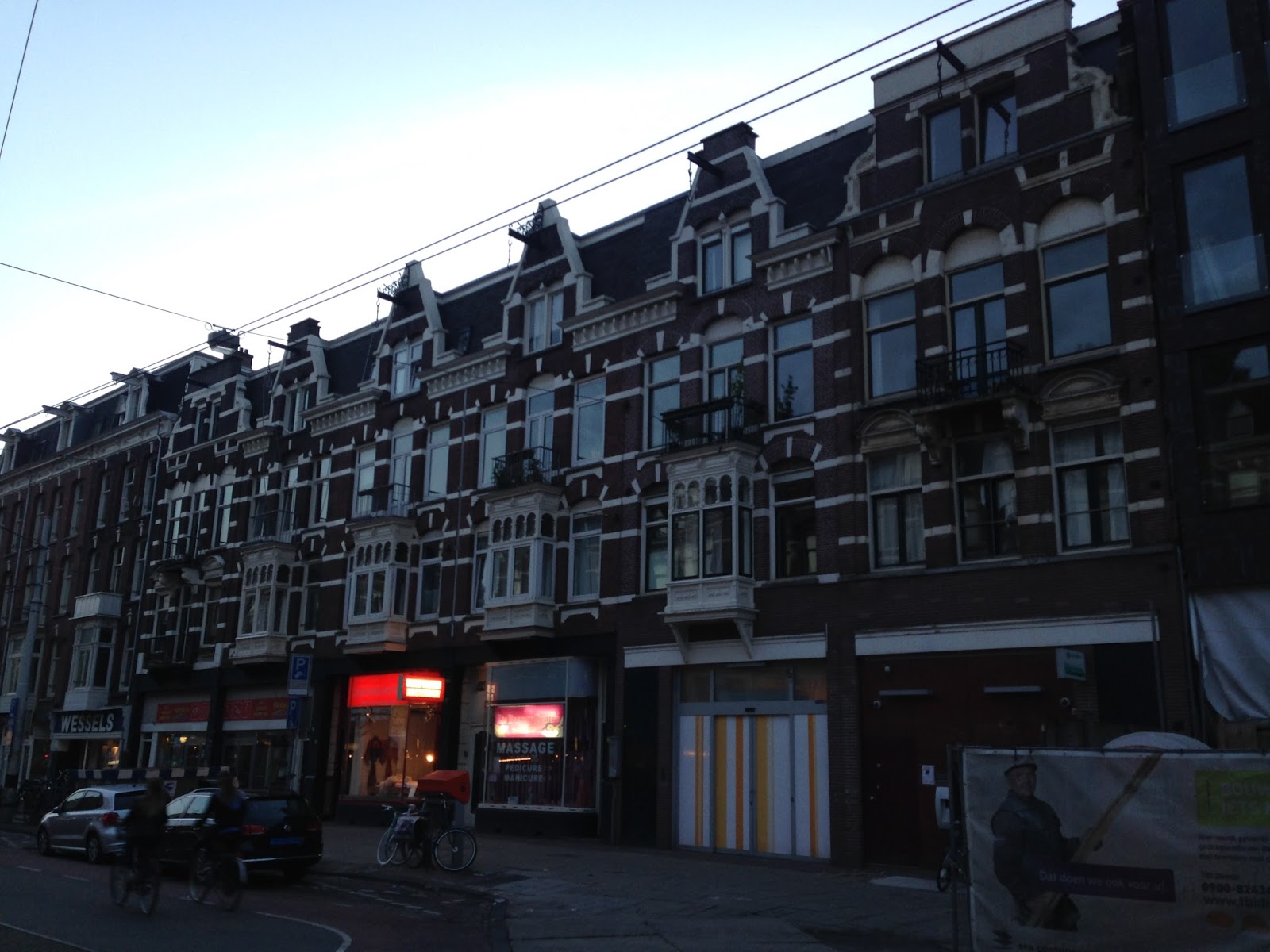

I had just had dinner at the Indonesian restaurant Dèsa and was on my way back to my hotel, waiting at a tram stop with a few other people. One tram pulled up, but the sign in Dutch on the front said something like, “No Stops.” Maybe the white Dutch couple, an older man with his wife, didn’t see the sign, having come up to the tram from the side. The man waved to the driver, but the driver didn’t open the door. The man began arguing, gesturing more forcefully, his face reddening as he became angrier, while the driver, who was not white, kept the door shut. The tram pulled up a bit farther to the red light where it continued to wait. The man charged past me, breathing heavily, and pounded on the tram’s plastic doors, yelling in Dutch at the driver. When the light turned green, the man pounded the doors one last time and yelled a single pointed word or phrase.

The tram pulled away, and the couple went across the street. The young man sitting on the bench next to me looked up and said something in Dutch. “I’m sorry,” I said.

“He’s drunk and he's racist,” the young man continued in English. “‘Fucking nigger.’ That's what he said.”

I nodded. “I thought it was something like that.”

“The first time I ever experienced discrimination,” he said, “was here. I’m from Suriname. In my country we don’t have racism.

“I have a business,” he continued, “laying carpets in hotels. I’m working near here.” He pointed down the street. “The owners of the hotel are Chinese. They never give me any problem.” He laughed. “I work six months here, then I go home for six months. I’m going home soon.”

The tram was taking a long time, and my hotel wasn’t that far, so I decided to walk back. I waved good night to him, wished him good luck, and he wished me the same.
  
I've been thinking about this encounter since I returned. The older white man was so certain of his own rightness that he continued to bang on the doors and berate the driver long past the time he should have read the sign, "No Stops," and long past the time he should have realized that there was no one on the bus. He wanted the driver to open the bus just for him and his wife, just because he said so, and when the driver didn't, the reason was not that the driver was simply doing his job but that the driver was deliberately antagonizing him. His racist slur stated, in effect, "You have no right to keep these doors closed to me because of who I am and who you are and the difference between us." The white man did not like the fact that, in this situation, he didn't have the upper hand and he was powerless to change it, and he lashed out with whatever power he felt he did have, the power of racial superiority, "I'm white, you're not, open these doors!" But the driver kept the doors closed. The sign stated it clearly, "No Stops." But the white man either didn't want to read the sign or didn't want to listen when it was a black man who was there to enforce those words.

And I've been thinking of the generosity of the young man who talked with me about his own life and his experiences with those like the racist man whose irrational anger we witnessed.

We need to keep our eyes open. We need to read the signs, especially those of us who occupy a position of privilege and have the tendency to ignore the voices of those without such privilege. We need to listen for the voice of Oyeyemi's house within us, telling us to eat the white chalk, refuse the stranger, close the borders, and we need to resist it. And most importantly, we need to listen to the living voices of those who are experiencing the effects of racism and xenophobia. They are speaking everywhere, on the street, at tram stops, in pubs and restaurants, in places of work, on Twitter and Facebook, online blogs and magazines, and their voices are clear and strong. We need to listen.

Saturday, May 21, 2016

"The Wood Thrush" on Wigleaf's Longlist of Top Very Short Fictions

Every year I eagerly await Wigleaf's Top 50 Very Short Fictions. This year Matt Salesses made some excellent selections, which I will be reading through over the next few weeks. I'm happy that my short story "The Wood Thrush," originally published in the Spring 2015 issue of Devil's Lake, made the Longlist. Thanks to the Wigleaf team for recognizing my story.

Wigleaf has been good to me over the years. In addition to publishing two microfictions of mine, Wigleaf also chose "Bible Camp" from SmokeLong Quarterly for the 2012 Longlist, and guest editor Brian Evenson chose "The Devil Called Satan Had Me for a Snack" for the 2010 Top 50. (These stories are all linked on the sidebar.)

Monday, May 16, 2016

After the Storm ...

My story "After the Storm, the Cement Ship" in Necessary Fiction was inspired by the wreckage of the cement ship at Seacliff State Beach in Aptos, California, and by the wreckage of a storm that hit Capitola Beach in Capitola, California, in the winter of 2010.


Some people built structures out of the wreckage ...

and as the days went on there were more and more of these little cabins dotting the beach.

I wanted to capture a mood of wreckage and ruin by linking these two spaces in the story, having the family walk through the storm wreckage to wind up at the ruin of the ship, while all around them mud is sliding, trees are falling, and the entire world is on the edge of collapse. These spaces are, in fact, linked geographically. On a clear day, one can see the cement ship from Capitola Beach, and on a really clear day, one can see the power plant at Moss Landing, the city of Monterey, and the hills of Carmel, as one follows the horseshoe curve around Monterey Bay.


Friday, May 13, 2016

New Story in Necessary Fiction

My flash fiction "After the Storm, the Cement Ship" is the featured story this week at Necessary Fiction.

The cement ship in the story is based on the S.S. Palo Alto at Seacliff State Beach in Aptos, California. It's a place I've visited with my family a number of times, and I've always loved this ugly ruin squatting in the midst of this otherwise sublime landscape. Its history is one of disuse and failed promise, with a period of short-lived glamour. It was an oil tanker intended for use in WWI, but the war ended before it ever sailed. It sat for ten years in a shipyard until it was repurposed as a tourist destination for dining and dancing; it had a neon sign and a swimming pool. But only two years later the ship cracked and its glamour faded and it just sat there in the water, eventually becoming a fishing pier, and when it finally corroded too much to be safe, was closed to public access. Now it's a habitat for birds and marine life.

This is a picture I took in March of 2007 standing at the gate at the end of the pier:


And a closeup through the gate:


On our visit in August of 2012 there were a lot of birds:


You can read more about the ship here, here, and here.


In my next post, I'll show some pictures from the storm that also inspired the story.

Tuesday, February 02, 2016

"Dead End" in Yemassee 22.2

My flash fiction "Dead End" is in the current issue of Yemassee. Thanks to Chris Koslowski, Justin Brouckaert, and the rest of the staff for putting me in this issue among a host of excellent writers.


When Sissy and I wandered our new neighborhood, the kids would scatter at our approach, huddle more tightly over their games, climb into their treehouses and spy at us through paper towel tubes. Once I got hit with a rain of pinecones and Sissy raged around in a circle, trying to catch out the source of the laughter that rang from every hiding place.

Tuesday, October 20, 2015

Fairy Tale Review Interview

Many thanks to Managing Editor Joel Hans and Fairy Tale Review for asking me some great questions about automatons and dementia as part of their "Pins and Needles" series on the Fairy Tale Review blog.
"For me, the uncanniness of wind-up toys and automatons is that they enable the fantasy of our own reality—I am an independent, self-sufficient individual with the agency to determine my own future—while also undermining that fantasy."
My story "Wind-Up Toy" is in the current issue, the Mauve Issue, and you can read an excerpt of it below the interview.

Monday, June 15, 2015

"The Wood Thrush" in Devil's Lake

My flash fiction, "The Wood Thrush," is in the Spring 2015 issue of Devil's Lake.

I followed Sissy up a path where the oak leaves had left their green handprints in the mud. I never recognized any of the forks and byways she took me down. It was as if the birds had sung her a secret map.

Wednesday, March 25, 2015

Fairy Tale Review, The Mauve Issue

My story "Wind-Up Toy" is in the most recent issue of Fairy Tale Review, The Mauve Issue.


If you're on Goodreads, you should consider entering the Giveaway for one of two free copies of the journal. You can pre-order the issue here, and subscribe here. Another excellent issue--the 11th!--of this stellar journal of contemporary fairy tales.

Wednesday, March 18, 2015

Three Stories in NANO Fiction 8.2

My contributor's copies of NANO Fiction 8.2 arrived the other day, with a gorgeous wrap-around cover by Mercedes Helnwein.
I have three stories in this issue, all from a related project, as I discuss in the interview on the NANO Fiction web site. Here are the titles and first lines of the stories.

"House of Stars"

Daddy and the other men from the neighborhood came splashing down the creek toward our house, Daddy carrying Sissy in his arms and she writhing against him, raving.

"The New Kids"

These were rowdy and ill-behaved children and we didn’t belong here, Sissy and I decided.

"Old Voices"

There is a dead boy down in the wet basement.

And here is a recording of me reading this last story at NANO Fiction's Soundcloud page.

Order the issue or subscribe. I've been a subscriber for a few years now, and I always eagerly devour it every time it arrives.

Monday, March 02, 2015

Interview at NANO Fiction

Kirby Johnson at NANO Fiction was kind enough to ask me five questions about my three stories that appear in the latest issue, 8.2. There is also a recording of me reading one of the stories, "Old Voices." Here's the first sentence:

"There is a dead boy in the wet basement."

I hope you'll check it out and order the issue, which has a wonderful list of contributors and looks to be another excellent issue.

Friday, January 10, 2014

Article on Shirley Jackson in Gothic Studies

My article " 'Only One Antagonist': The Demon Lover and the Feminine Experience in the Work of Shirley Jackson" is in the latest issue of Gothic Studies. Here is the abstract:

One of the most prominent tropes in Shirley Jackson's work is that of the ‘demon lover’ who seduces a woman from her home with promises of riches and ultimately destroys her. Jackson uses the demon lover to figure a jouissance excluded by the Symbolic order, which, because of its repression, returns with a destructive force. Jackson's demon lover tales, including ‘The Daemon Lover’, ‘The Beautiful Stranger’, and ‘The Tooth’, narrate a woman's gradual realization of her subjection to a demonic male figure, whose claim on her dispossesses her of both home and self. Women in these stories are offered an impossible choice: either conform to a passive position within rigidly defined gender roles or be abjected into a permanent state of anxiety, insecurity, and even madness outside of the Symbolic order. Jackson's second novel Hangsaman (1951), more than any other of Jackson's works, attempts to chart a path for feminine jouissance by imagining writing as a kind of witchcraft.

Tuesday, December 03, 2013

Ford Madox Ford and the Misfit Moderns by Rob Hawkes

My review of Rob Hawkes's Ford Madox Ford and the Misfit Moderns: Edwardian Fiction and the First World War is in the current issue of Modernism/modernity (20.3).

Rob Hawkes’s engaging study of “misfit moderns” positions Ford Madox Ford alongside writers like Arnold Bennett, H. G. Wells, Joseph Conrad, Robert Graves, Siegfried Sassoon, Richard Aldington, and Rebecca West, all of whom in some way have an uneasy relation to modernism, either as non-modernists against whom the modernists defined themselves or as not-quite-modernists who never achieved the centrality of Joyce or Woolf. While these writers all have a place in Hawkes’s study, Ford is the primary focus, “the misfit par excellence” (22), because while he was an Edwardian like Bennett and Wells, he also wrote two modernist masterpieces, making him both a central figure within modernism and not fully of the period. Ford’s writing “occupies aesthetic territory between the conventional realist novel and high modernism” (2), a position of “in-betweenness” that, far from making Ford a “peripheral figure on the margins” of both Edwardians and moderns, “constitutes an acute and exemplary responsiveness to the conditions of modernity” (3).

Wednesday, September 11, 2013

Clandestine Encounters: Philosophy in the Narratives of Maurice Blanchot

My review of Clandestine Encounters: Philosophy in the Narratives of Maurice Blanchot edited by Kevin Hart (University of Notre Dame Press, 2010) is in the upcoming issue of Modern Philology (111.2) and also currently online for subscribers. This is an exceptional collection of essays for anyone interesting in Blanchot's work in general, but especially for those interested in his difficult, haunting fiction and other unclassifiable narratives. Each essay focuses on a different work and is arranged chronologically, from his earliest récits to his final autobiographical narrative L’instant de ma mort. Highly recommended.

Thursday, August 01, 2013

Review in the TLS

My book was reviewed by Lauren Arrington in the In Brief section of 26 July 2013 Times Literary Supplement

As Shell Shock and the Modernist Imagination progresses, Bonikowski's arguments gain momentum, coalescing in his powerful point that in the aesthetic sublimation of the death drive, modernist fiction can 'sustain the pleasures of life.'

Monday, May 06, 2013

Narrative 2013

I'm presenting a paper on Barbara Comyns at the Narrative Conference in Manchester, UK, this June. Here's my abstract:


Lightness of Voice and the Levitating Narratives of Barbara Comyns

The British writer Barbara Comyns wrote eleven well-received novels from the late 1940s to 1990, but she has been largely neglected in terms of scholarly attention. (The MLA bibliography lists one academic article, and she is briefly noted in a handful of monographs covering mid-century British fiction.) My paper seeks to bring renewed attention to this overlooked writer by focusing on what most commentators have mentioned admiringly, but only in passing: her distinctive voice. Drawing on James Phelan’s description of voice in Narrative as Rhetoric, I will examine how voice connects to both character and plot in two of Comyns’s novels: Our Spoons Came from Woolworths (1950) and The Vet’s Daughter (1959). I will argue that Comyns’s use of voice creates narrators particularly attuned to the undercurrent of violence that subsists within social relations. These narrative voices, spoken in homodiegetic narration by young women, are often described as simple, matter-of-fact, honest, and naïve. But another quality is also present, an “authority of address” and “method of seduction” (Davis viii, x), a “marvelousness,” “childlike wonder,” and “lightness (in Calvino’s usage of the term)” (Evenson vi). These voices, both naïve and seductive, straightforward and full of wonder, create uncanny effects in Comyns’s often darkly comic narratives, presenting the narrators as both ignorant and knowing: ignorant of normative social conventions while possessing an outsider’s knowledge of the violence that lies within them. If these narrators are often the passive victims of violence, their traumatic knowledge (Hartman) uncannily lifts them above these experiences, offering them the means to find a language for the traumatic effects of violence that that would not otherwise find expression in the normative discourses surrounding them. This lifting-above—literalized in the surreal and Gothic touches found in Comyns’s work, such as visions and levitation—is what accounts for the clear-eyed wonder and lightness of the voice.

Works Cited
Davis, Kathryn. Introduction. The Vet’s Daughter. By Barbara Comyns. New York: New York Review Books, 2003. vii-xi.
Evenson, Brian. Introduction. Who Was Changed and Who Was Dead. By Barbara Comyns. Urbana, IL: Dorothy, a publishing project, 2010. i-vii.
Hartman, Geoffrey. “On Traumatic Knowledge and Literary Studies.” New Literary History 26.3 (1995): 537-63.

Sunday, March 03, 2013

Shell Shock and the Modernist Imagination

My book Shell Shock and the Modernist Imagination: The Death Drive in Post-World War I British Fiction is now available from Ashgate Press.
Looking closely at both case histories of shell shock and Modernist novels by Ford Madox Ford, Rebecca West, and Virginia Woolf, Wyatt Bonikowski shows how the figure of the shell-shocked soldier and the symptoms of war trauma were transformed by the literary imagination. Situating his study with respect to Freud’s concept of the death drive, Bonikowski reads the repetitive symptoms of shell-shocked soldiers as a resistance to representation and narrative. In making this resistance part of their narratives, Ford, West, and Woolf broaden our understanding of the traumatic effects of war, exploring the possibility of a connection between the trauma of war and the trauma of sexuality. Parade’s End, The Return of the Soldier, and Mrs. Dalloway are all structured around the relationship between the soldier who returns from war and the women who receive him, but these novels offer no prospect for the healing effects of the union between men and women. Instead, the novels underscore the divisions within the home and the self, drawing on the traumatic effects of shell shock to explore the link between the public events of history and the intimate traumas of the relations between self and other.

Tuesday, February 12, 2013

From an interview with Mary Caponegro:

"I work from ideas and images and abstractions—from an impulse to conflate the sensual and the abstract, and from an impulse to generate a species of music. For a writer such as myself, who wishes to blur the line between fantasy and reality, a crisp delineation of character and setting, etc. would not serve my purpose—whereas the creation of a mood or texture might be utterly crucial. Plot might be quite intricate, but in ways likely comprised more of nuance than event. I suppose that in my work, character tends to become merely a prop for voice, and often there are very few characters, perhaps only one speaker who refers to other characters and whom the reader experiences only through that 'central intelligence.' But when characters do figure, they might have quite defined attributes. My interest is, I think, to explore them more from the inside out than from the outside in, if you will—laying bare their psyches through involution of syntax, as if syntax itself were the objective correlative—rather than giving a host of external details from which the reader can deduce internal 'truths.' One could view my work as a fiction of the psychological epiphenomena of event. My tendency toward abstraction may be felt by some conventional readers to hold them at a distance, but I hope the psychological intensity compensates for this."