The University of Amsterdam, it turns out, is pretty tricky
to find for someone like me who had never been to Amsterdam before and has poor
spatial and directional sense. Fortunately, I found a group of fellow conference
attendees and together we managed to find our way through a tunnel and into a
courtyard that led to the main building where the conference was being held. It
was here I took a picture of the outer wall of the tunnel that houses the
Oudemanhuispoort book stalls:
I took the picture because I liked the Banksy-style stencil
art and the chance element of the weed growing in such a way that it looks like
the woman is peering from behind it, as if hiding. But I'm also glad I included
the engraved stone plaque on the wall:
If you can't read it on the picture, here are the words: "Toen is in mij het bewustzijn ontwaakt
dat een van de taken van de historicus, de man die schrijft over de mensen van
vroeger, is de doden stem te verlenen. De doden moeten kunnen spreken en als
men hen het spreken belemmert dan sterven ze tweemaal. J.P."
I don't read or
speak Dutch, nor did I realize who J.P. was until later when I did some
research looking for the quotation. Before traveling to Amsterdam, I read Geert Mak's
Amsterdam to get a sense of the history
of the city. As one might imagine, the most harrowing part of the book was
Mak's description of the treatment of the Jews in Amsterdam during the Nazi
occupation, for which he relies heavily on the work of historian Jacques
Presser. If you know this history and you know Presser, who was a professor at
the University of Amsterdam, then you know that this is who J.P. is. Here is a
more complete quotation from which the above quote comes, from
Gesprekken met Jacques Presser
(Conversations with Jacques Presser) by Philo Bregstein (quoted here in
an article by Adriaan Venema):
“Ik lees het en voor mij heeft praktisch niemand het gelezen
en na mij gaat de boel een archief in en zal er vermoedelijk geen haan ooit
meer naar kraaien. Toen is in mij het
bewustzijn ontwaakt dat een van de taken van de historicus, de man die schrijft
over de mensen van vroeger, is de doden stem te verlenen. De doden moeten
kunnen spreken en als men hen het spreken belemmert dan sterven ze tweemaal. Daar
hoor ik zelf van op, dat klinkt rijkelijk aan de theatrale kant, ik kan er
niets aan doen. Wie de doden het zwijgen oplegt, laat ze tweemaal sterven...”
These interviews with Jacques Presser have not been
translated into English, as far as I know, but I found a translation of some of
these words in the
Afterword to materials for the film
The Past That Lives, about Jacques
Presser:
“When you have worked, as I have, for about fifteen years
with these documents, you are continuously confronted with the dead, the voices
of the deceased. I read these papers, the little scraps of paper, thrown from
the train, the rare messages coming from Westerbork ... Before me, hardly
anyone has read them and, after me, they are locked into the archives and it's
possible that nobody else will see them. They
awoke in me the awareness that one of the tasks of the historian, the man who
writes about people in the past, is to give the dead a voice. The dead must be
able to speak ... and anyone who lets the dead remain silent allows them to die
twice, and I have simply refused to permit that.”
In Amsterdam,
Geert Mak quotes postwar testimony from a Holocaust survivor from Amsterdam:
"The Netherlands has carried out the biggest public relations exercise to
follow the Second World War by using the diary of Anne Frank to give the
impression that the Jews were all in hiding here, and that the entire Dutch
population was in the Resistance." Mak continues: "the Dutch still
have a tendency to talk up the extent of their resistance to almost mythical
proportions. In reality, proportionally more Jews were deported from the
Netherlands than from any other Western European country."
The conference I was attending at the University of
Amsterdam was
Narrative 2016, the annual conference of the
International Society for the Study of Narrative. I was there to deliver a paper on
British-Nigerian writer Helen Oyeyemi’s 2009 novel
White Is for Witching, which, to greatly simplify, is about a young girl
named Miranda who, in order to grow up and live an independent life, must first
escape the house she has lived in for much of her life, a house that, in Gothic
tradition, has a will of its own—in this case, an isolationist, xenophobic, and
racist will. The house’s xenophobia was born out of the reactionary fear of the
enemy during and after the Second World War, a fear that inspired in the house a hostility toward
outsiders and a desire to protect the family by sealing them off from others’
influence. The present day crisis of the novel comes when the house is opened
as a bed-and-breakfast. Unwilling to offer hospitality to others, it drives
them away. As the house states directly, “They shouldn’t be allowed in, those
others, so eventually I make them leave.”
The house targets especially its non-white guests and staff,
terrorizing the Azerbaijani family who work and live there, the new Nigerian housekeeper
who is hired after they flee, and a black British couple who attempt to
vacation there. When Miranda brings home her girlfriend Ore, whose mother was
born in Nigeria, the house describes the relationship as “disgusting” and
invades Ore’s mind with hallucinatory thoughts that her black skin is coming
off on the towels after she takes a shower, while outside the bathroom door she
hears voices singing “Rule Britannia!” Later she discovers her room covered in
British National Party leaflets: “Do you
know how many immigrants are in the UK? Neither does the UK government …”
The novel is set in Dover during a crisis of stabbings of Kosovan
refugees, stories of which appear regularly in The Dover Post. Meanwhile, the Nigerian housekeeper Sade visits the
local Immigration Removal Center to visit with those there and bring them food.
At one point, Sade returns home distraught because a young man at the Removal
Center has hanged himself. She tells Miranda: “I’m thinking of the shame. To
make a man hang himself. That place is a prison. You come without papers
because you have been unable to prove that you are useful to anyone, and then
when you arrive they put you in prison, and if you are unable to prove that you
have suffered, they send you back. That place up there is a prison. He didn’t
deserve that.”
But despite her relationship with Ore, despite her
encounters with the sufferings of refugees, Miranda cannot escape the
xenophobic influence of the house. One of the ways the house keeps its hold on
her is through an eating disorder called pica, passed down through the women of the family
who have grown up in the house. Pica, as the novel tells us, “is an appetite
for non-food items, things that don’t nourish.” For Miranda, this means eating
bits of plastic and, significantly in terms of the novel’s symbolism, chalk.
For this is Dover of the famous white chalk cliffs and the famous Vera Lynn song
that, in the same year the novel was published,
was being used by the BNP to
promote their white nationalist ideology. Throughout the novel Miranda eats
white chalk, as if ingesting the house’s xenophobia. Ultimately, the house and
its ideology devour her: she remains trapped in a wall of the house, eating
(white) plaster.
The day after I returned to the U.S. from Amsterdam was
World Refugee Day, the day the UNHCR released its
annual report, which stated
"65.3
million people, or one person in 113, were displaced from their homes by
conflict and persecution in 2015," the largest number since UNHCR has been
keeping records.
Miranda’s fate in Oyeyemi’s novel—the home of the isolated self
intertwined with the home of the isolationist nation as they feed on each other—may
very well be the fate of England after Brexit: police the borders, determine
who belongs, exclude those who are deemed outsiders, and eat itself to death.
This might be fine if it didn’t have real consequences for those excluded
others.
While one narrative of Brexit focuses on working-class
antagonism toward elites, this narrative obscures the way the Leave campaign
relentlessly used the language of “taking our country back” and a suspicion of “open
borders” to draw on anti-immigrant fears.
And recent reports from the UK bear this out. Polish people and other eastern Europeans as well as anyone who doesn't fit some perceived notion of Britishness are finding themselves subject to xenophobic and racist attacks.
Anyusha Rose argues that “the Brexit debate is
normalizing British racism,” and gives as one example a conversation she had in
a pub in which a man, after wondering why the killer of Jo Cox couldn’t have
killed a foreigner instead, asked Rose (who is “mixed race, and London born and
bred”), “Where are you
really from?”
Joseph Harker writes, “Yes, the immigration issue has been about numbers coming
from eastern Europe, and about people who don’t have English as their first
language. But as anyone with a black or brown face knows, our nationality is
regularly questioned, even when we’re born here.” On my Facebook feed, friends
and friends of friends are posting real-time instances of racist hate speech directed
against them in the wake of Brexit.
A Facebook page, "Worrying Signs," has been created to help document these instances.
Far-right parties in Europe are now using Brexit as an
opportunity to further stoke the fears and rage, the racism and xenophobia of
this populist wave. Both
Geert Wilders of the Netherlands’ PVV (Party for Freedom)
and
Marine Le Pen of France’s National Front came out in the wake of the UK
vote to champion their own versions of Brexit.
The rise of right-wing glee after Brexit has
Joseph Harker writing, “This morning, knowing these despicable tactics have won over the
nation, it feels like a ‘First they came for the Poles’ moment. It seems only a
matter of time before the intolerance that has been unleashed, reinforced and
normalised, looks for the old, easy targets of people who look different.
People like me.” And if this sounds exaggerated to anyone (it doesn't to me), just note the language of the signs placed in letterboxes in Huntingdon, Cambridgeshire, which has the ring of the 1930s: "No more Polish vermin."
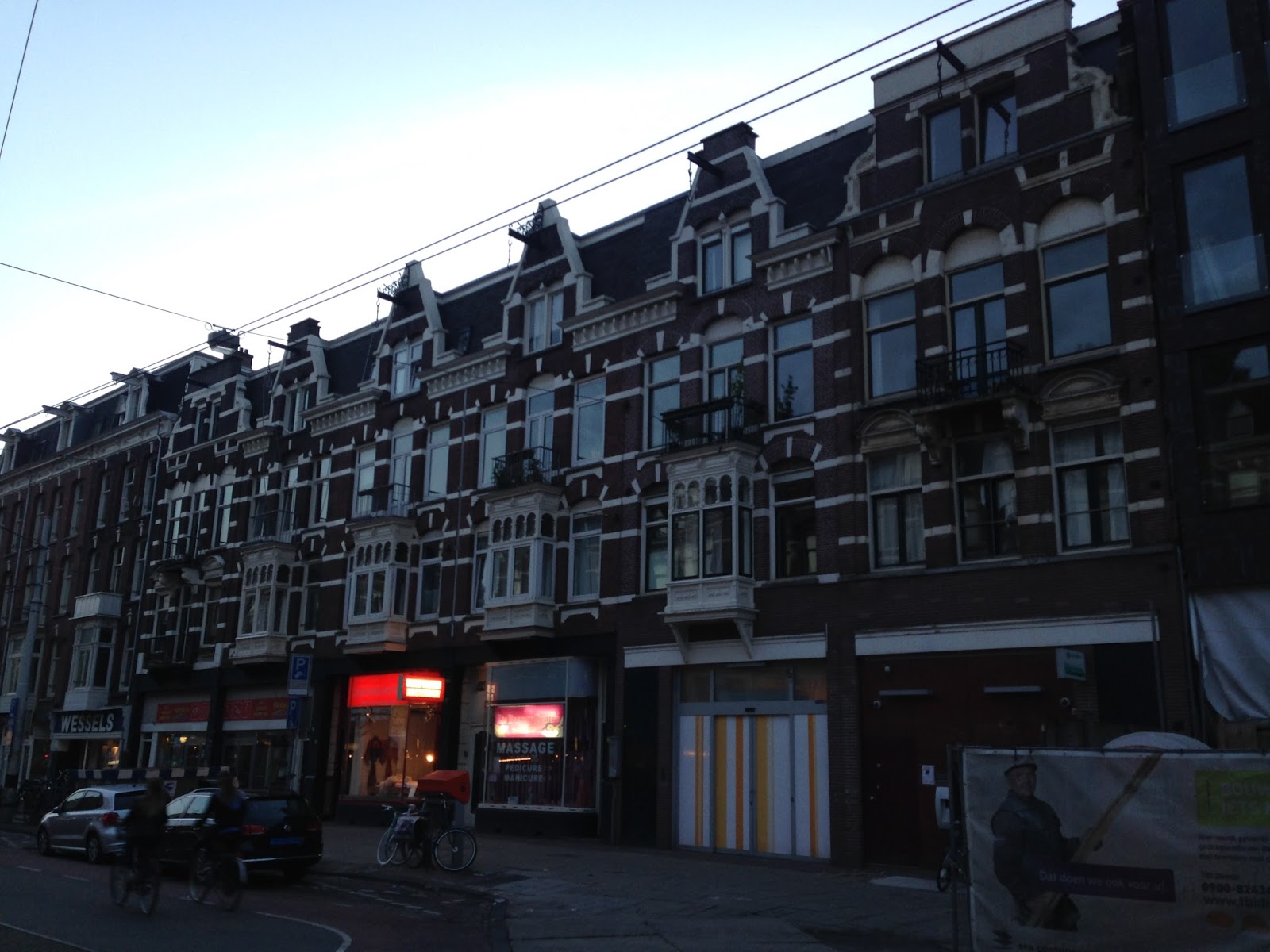
The third night of my stay in Amsterdam I took this picture
of a row of shops and residences, hoping to capture something of the
architecture of the typical street in this section near the neighborhood of De Pijp. This was one of the areas where, in the early 20th century, Jewish
workers moved as they left the old Jewish sector of the city and integrated more
into other neighborhoods, a time which, before the Second World War and the Nazi occupation, must have seemed like the promise of progress.

I had just had dinner at the Indonesian restaurant
Dèsa
and
was on my way back to my hotel, waiting at a tram stop with a few other people. One tram pulled
up, but the sign in Dutch on the front said something like, “No Stops.” Maybe the white Dutch
couple, an older man with his wife, didn’t see the sign, having come up to the
tram from the side. The man waved to the driver, but the driver didn’t open the
door. The man began arguing, gesturing more forcefully, his face reddening as
he became angrier, while the driver, who was not white, kept the door shut. The
tram pulled up a bit farther to the red light where it continued to wait. The man charged past me, breathing heavily, and
pounded on the tram’s plastic doors, yelling in Dutch at the driver. When the
light turned green, the man pounded the doors one last time and yelled a single
pointed word or phrase.
The tram pulled away, and the couple went across the street.
The young man sitting on the bench next to me looked up and said something in Dutch. “I’m
sorry,” I said.
“He’s drunk and he's racist,” the young man continued in English. “‘Fucking
nigger.’ That's what he said.”
I nodded. “I thought it was something like that.”
“The first time I ever experienced discrimination,” he
said, “was here. I’m from Suriname. In my country we don’t have racism.
“I have a business,” he continued, “laying carpets in
hotels. I’m working near here.” He pointed down the street. “The owners of the hotel
are Chinese. They never give me any problem.” He laughed. “I work six months
here, then I go home for six months. I’m going home soon.”
The tram was taking a long time, and my hotel wasn’t that
far, so I decided to walk back. I waved good night to him, wished him good
luck, and he wished me the same.
I've been thinking about this encounter since I returned. The older white man was so certain of his own rightness that he continued to bang on the doors and berate the driver long past the time he should have read the sign, "No Stops," and long past the time he should have realized that there was no one on the bus. He wanted the driver to open the bus just for him and his wife, just because he said so, and when the driver didn't, the reason was not that the driver was simply doing his job but that the driver was deliberately antagonizing him. His racist slur stated, in effect, "You have no right to keep these doors closed to me because of who I am and who you are and the difference between us." The white man did not like the fact that, in this situation, he didn't have the upper hand and he was powerless to change it, and he lashed out with whatever power he felt he did have, the power of racial superiority, "I'm white, you're not, open these doors!" But the driver kept the doors closed. The sign stated it clearly, "No Stops." But the white man either didn't want to read the sign or didn't want to listen when it was a black man who was there to enforce those words.
And I've been thinking of the generosity of the young man who talked with me about his own life and his experiences with those like the racist man whose irrational anger we witnessed.
We need to keep our eyes open. We need to read the signs, especially those of us who occupy a position of privilege and have the tendency to ignore the voices of those without such privilege. We need to listen for the voice of Oyeyemi's house within us, telling us to eat the white chalk, refuse the stranger, close the borders, and we need to resist it. And most importantly, we need to listen to the living voices of those who are experiencing the effects of racism and xenophobia. They are speaking everywhere, on the street, at tram stops, in pubs and restaurants, in places of work, on Twitter and Facebook, online blogs and magazines, and their voices are clear and strong. We need to listen.