Wednesday, May 30, 2012
I am very happy to see "Bible Camp" on the long list of Wigleaf's Top (Very) Short Fictions of 2012. Thanks to Scott Garson and Ravi Mangla for including my story and for creating this list every year, which is such a wonderful resource for everyone interested in the form of the short short story. (Here's the link to the Top 50.) I see that Ravi is stepping down from his role as Series Editor for this list and that Lauren Ellen Scott will take over, along with Mel Bosworth, Erin Fitzgerald, and Sean Lovelace. It'll be exciting to see what the next year will bring.
Thursday, February 02, 2012

My story "Little Man" is in Fairy Tale Review (The Grey Issue), guest edited by Alissa Nutting. It will debut at AWP this month. I'm really excited to see the issue. Just look at the list of contributors. From the web site:
"2012’s Fairy Tale Review (The Grey Issue) is our eighth annual issue and will debut at the 2012 AWP Convention in Chicago, going up for sale at SPD at the same time. It is a themed issue, dedicated to lost boys and lost girls. In the Editor’s Note, Alissa Nutting, author of Unclean Jobs for Women and Girls, writes: “ Getting lost is one of the most widely used narrative vehicles of all time. Once characters become lost, they can stumble upon anything—it’s a light speed bullet train between credibility and suspension of disbelief. Falling down a rabbit hole or stepping off the trail in a labyrinthine wood can transport a character to another world entirely in a manner of seconds.” Contributors to The Grey Issue are Seth Abramson, Matt Bell, Molly Bendall, Wyatt Bonikowski, Brittany Cavallaro, Maile Chapman, Mimi Chubb, Tara Goedjen, Sara Gong, Carol Guess, Aireanne Hjelle, Desiree Holman, Ashley Elizabeth Hudson, Shane Jones, Jessica Joslin, Krystal Languell, David Lasky, Stacey Levine, Oksana Marafioti, Adam McOmber, Christopher Merkner, Benjamin Nadler, Andi Olsen, Lance Olsen, Daniela Olszewska, David James Poissant, Gretchen Steele Pratt, Imad Rahman, Matthew Salesses, Kevin Sampsell, Davis Schneiderman, J. A. Tyler, Lee Upton, Laura Van Den Berg, Rob Walsh, Jillian Weise, Kellie Wells, Elizabeth Clark Wessel, Deborah Woodard, John Dermot Woods."
Tuesday, June 28, 2011
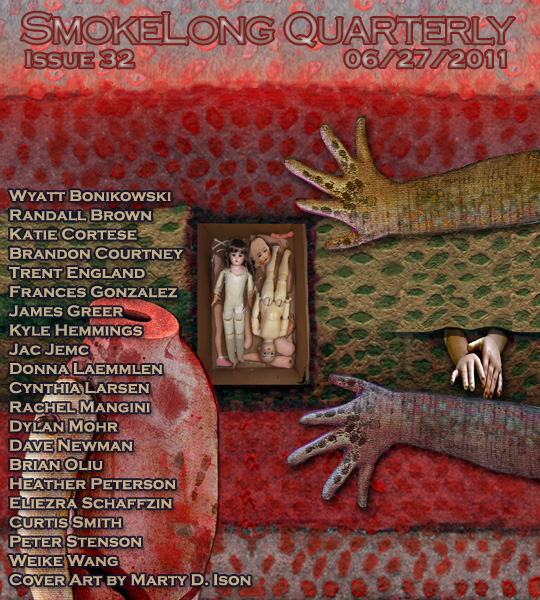
My story "Bible Camp" is in the new issue of SmokeLong Quarterly, chosen by xTx when she was Guest Editor. I mentioned this a couple weeks ago, but what's new is the short interview that xTx did with me about the story, which you can read here.
Tuesday, June 14, 2011
If you're in the Boston area and have a chance to see Jim Shepard read either tonight at Newtonville Books or tomorrow night at Harvard Bookstore, do so! Not only is he an incredible writer and his new collection, You Think That's Bad, one of the best short story collections I've read in recent years, but he's a very entertaining reader of his work. Even more, he's a great guy and generous with students, as we found this past April when he accepted my invitation to visit Suffolk University to give a reading from the new book and meet with creative writing students. Go see him read. Buy the book. Read stories about apocalyptic floods in the Netherlands, the invention of the Godzilla monster, the 15th century mass murderer Gilles de Rais, and many others, and marvel at his ability to be so damn convincing about all of it.
Monday, June 13, 2011
I'm happy to announce that my story "Bible Camp" is featured this week at SmokeLong Quarterly, chosen by Guest Editor xTx, author of Normally Special. And it is accompanied by some beautiful art by Shannon Reynolds.
Thursday, June 09, 2011
An eclectic summer reading list so far:
Sisters by a River, Barbara Comyns's first novel (1947)
Hangsaman, Shirley Jackson's second novel (1951), which I re-read along with a handful of favorite Jackson short stories, "The Daemon Lover," "The Beautiful Stranger," "The Tooth," and "The Rock." Also her children's book, The Witchcraft of Salem Village (1956).
A bunch of Tintin books, which I'm reading with my daughter, along with Tom McCarthy's Tintin and the Secret of Literature, which I'm not reading with my daughter.
Currently reading Rebecca West's The Meaning of Treason and the new collection of previously uncollected prose The Essential Rebecca West.
---
The internet is a lovely thing. In doing a bit of Google-searching on William Joyce, the British fascist hanged for treason who is the subject of the first essay in West's book mentioned above, I was reminded of David Britton's Lord Horror novels and comics, none of which I've actually read, but in which Joyce appears ("Lord Horror" is a play on Joyce's radio broadcast nickname "Lord Haw-Haw"). Following some links I came across the work of artist John Coulthart, who produced with David Britton the Lord Horror comic Reverbstorm, and who has a blog full of fascinating reading. (He's working on something new with Alan Moore called The Soul as well.) One of his recent blog entries, among other interesting items, links to China Miéville on Lord Horror and other alternative histories of note, including the film Notting Hill (see link and also below).
Meanwhile, on one of my favorite web sites, Montevidayo, Joyelle McSweeney and Johannes Göransson are writing about China Miéville, monsters, kitsch, and jouissance.
I'll leave with this quotation from Miéville's summary of Notting Hill:
"To celluloid, and a movie of brilliant, chilling, minatory vision. Roger Michell and Richard Curtis's is a dystopian image of contemporary London after the triumphant rise of some unseen fascist authority. With searing rage, the film underscores the totality of this victory, this dreadful alternative path, in its depiction of Notting Hill, famous for its Afro-Caribbean community and culture, as successfully ethnic cleansed. An area defined by diversity, the history of the British Black Power movement, the Mangrove restaurant, Claudia Jones and social struggle, is, with satire more bitter than Dean Swift's, stripped of people of colour, the streets instead wholly populated with mindless, twittering, wittering, lily-white rich. There is no more Carnival, with its history in struggle and play, nor shall there ever be again. A bravura cinematic hell to be shelved alongside Pasolini's Salò."
Sisters by a River, Barbara Comyns's first novel (1947)
Hangsaman, Shirley Jackson's second novel (1951), which I re-read along with a handful of favorite Jackson short stories, "The Daemon Lover," "The Beautiful Stranger," "The Tooth," and "The Rock." Also her children's book, The Witchcraft of Salem Village (1956).
A bunch of Tintin books, which I'm reading with my daughter, along with Tom McCarthy's Tintin and the Secret of Literature, which I'm not reading with my daughter.
Currently reading Rebecca West's The Meaning of Treason and the new collection of previously uncollected prose The Essential Rebecca West.
---
The internet is a lovely thing. In doing a bit of Google-searching on William Joyce, the British fascist hanged for treason who is the subject of the first essay in West's book mentioned above, I was reminded of David Britton's Lord Horror novels and comics, none of which I've actually read, but in which Joyce appears ("Lord Horror" is a play on Joyce's radio broadcast nickname "Lord Haw-Haw"). Following some links I came across the work of artist John Coulthart, who produced with David Britton the Lord Horror comic Reverbstorm, and who has a blog full of fascinating reading. (He's working on something new with Alan Moore called The Soul as well.) One of his recent blog entries, among other interesting items, links to China Miéville on Lord Horror and other alternative histories of note, including the film Notting Hill (see link and also below).
Meanwhile, on one of my favorite web sites, Montevidayo, Joyelle McSweeney and Johannes Göransson are writing about China Miéville, monsters, kitsch, and jouissance.
I'll leave with this quotation from Miéville's summary of Notting Hill:
"To celluloid, and a movie of brilliant, chilling, minatory vision. Roger Michell and Richard Curtis's is a dystopian image of contemporary London after the triumphant rise of some unseen fascist authority. With searing rage, the film underscores the totality of this victory, this dreadful alternative path, in its depiction of Notting Hill, famous for its Afro-Caribbean community and culture, as successfully ethnic cleansed. An area defined by diversity, the history of the British Black Power movement, the Mangrove restaurant, Claudia Jones and social struggle, is, with satire more bitter than Dean Swift's, stripped of people of colour, the streets instead wholly populated with mindless, twittering, wittering, lily-white rich. There is no more Carnival, with its history in struggle and play, nor shall there ever be again. A bravura cinematic hell to be shelved alongside Pasolini's Salò."
Friday, January 21, 2011
"Then I decided that this disorder and this dilemma, revealed by my desire to write on Photography, corresponded to a discomfort I had always suffered from: the uneasiness of being a subject torn between two languages, one expressive, the other critical; and at the heart of this critical language, between several discourses, those of sociology, of semiology, and of psychoanalysis--but that, by ultimate dissatisfaction with all of them, I was bearing witness to the only sure thing that was in me (however naïve it might be): a desperate resistance to any reductive system."
Roland Barthes, Camera Lucida
Roland Barthes, Camera Lucida
Tuesday, November 16, 2010

Charles Burns's X'ed Out makes me hope the next volume comes out much more quickly than Black Hole, which took ten years. First of all, the book looks beautiful, over-sized and brilliant color, reminding me a bit of those reprinted hardcover EC horror comics that I subscribed to as a young teenager. Burns has mashed up EC with Tintin into a kind of horror-adventure dreamscape. It's hard to keep track of the narrative, the multiple times and spaces Burns is playing around with. We open with a Tintin look-alike following his dead cat into an exotic, desert village, where a guide eventually helps him find something to eat--eggs--and tells him that a woman they see passing is the new queen of what appears to be a large beehive (this serves as the cliffhanger that ends the book). This part of the narrative--which we cut back to throughout the book--appears to be the vivid dream world of the main character Doug, who has been in some sort of accident (he has a bandage on his head), has haunting memories of his father, and has been (still is?) involved in an intense relationship with a photographer who has a predilection for pig fetuses and self-mutilation. Doug is something of an amateur performance artist who wears a Tintin mask and calls himself Nitnit while playing a tape of ambient noise and reading cut-up text inspired by Burroughs.
Also, large red speckled eggs make multiple appearances.
The above makes this work sound jumbled, as cut up as Burroughs perhaps, but instead of frenetic energy, we get cool, elegant, and haunting threads of story and a tension between playful wry humor and the earnest yearning of teenage angst. But what impresses me most about Burns's work, and this is true of Black Hole as well, is way the narrative follows an associative dream logic, in which repeated images surface in different contexts, vibrating with a palpable meaning that remains out of reach. The narrative is circling something (what's in those eggs? what's through that hole?), a navel, as Freud might call it, "the spot that reaches down into the unknown." One never knows what will emerge--part of the pleasure of this sort of narrative--but it will likely be both horrifying and fascinating, it will repeat itself endlessly in different guises, it will never fully come to light.
Tuesday, June 01, 2010
Leslie Scalapino (1944-2010)
Obituary
Ron Silliman's extensive list of links, which includes some of her essays and poetry, audio readings, and reviews and discussions of her work.
One of the first books I began reading this summer after grades were due was Scalapino's selected poems It's go in horizontal (reviewed here in Jacket), and I am looking forward to reading her most recent book, Floats Horse-Floats or Horse-Flows (reviewed here at Tarpaulin Sky).
Reading Scalapino is having your mind patiently fractured, your grammar interrupted by another grammar, and by mind and grammar I mean also perception of the body, of the social and political as outside crossing inside, being thought one word at a time, word and pause, pause and word. You must pay attention.
Obituary
Ron Silliman's extensive list of links, which includes some of her essays and poetry, audio readings, and reviews and discussions of her work.
One of the first books I began reading this summer after grades were due was Scalapino's selected poems It's go in horizontal (reviewed here in Jacket), and I am looking forward to reading her most recent book, Floats Horse-Floats or Horse-Flows (reviewed here at Tarpaulin Sky).
Reading Scalapino is having your mind patiently fractured, your grammar interrupted by another grammar, and by mind and grammar I mean also perception of the body, of the social and political as outside crossing inside, being thought one word at a time, word and pause, pause and word. You must pay attention.
Monday, May 24, 2010
Wigleaf has announced its Top 50 very short fictions 2010, selected by Brian Evenson. I'm happy to say my story "The Devil Called Satan Had Me for a Snack" made the list (see the stories in Action, Yes on the sidebar), and even happier to be in the company of such excellent work, both on the Top 50 and the long list. Editor Scott Garson is a great champion of this form, and he's doing a real service to writers and readers in highlighting these fictions and the journals that publish them, as he's been doing for the past few years. His foreword and Evenson's introduction are both worth reading. Garson is right that this is a "boom time" for very short fiction (which Garson's rules for selection define as under 1000 words), largely because of the editors of web journals who support this new-ish genre and the "real openness," as Garson puts it, that the form demands of both writers and readers. As Evenson writes, "The future of short-short fiction seems to me increasingly to be found online."
Saturday, February 27, 2010
Those who braved the weather to walk against 55-mph winds and sideways rain and make their way to Suffolk University's Poetry Center in the Sawyer Library, overlooking Boston's Granary Burying Ground (one of my favorite views in the city), this past Thursday evening were rewarded with J. Robert Lennon's lively reading of stories from Pieces for the Left Hand, Oulipean exericses (e.g., sentences made out of every letter of the alphabet), and, the main event, a brand new and very funny short story about a college campus tour. Lennon is an engaging and inspiring speaker, and a great guy all around. I had a wonderful time chatting with him about our mutual love of David Foster Wallace, our interests in genre fiction, and hobbies such as music, cooking, photography, and raising chickens. Those hobbies are mostly his, by the way. How he has time to get any writing done is a mystery to me. He was also an excellent additional voice in that day's fiction workshop, which I'm sure the two students whose stories were discussed especially appreciated, and we all learned from.
If you don't already know Lennon's work, I urge you to seek it out. Pieces for the Left Hand, his collection of 100 (!) short short stories about a small town in upstate New York, and Castle, a haunting gothic novel that becomes a surprisingly relevant commentary on our post-9/11 world, are his most recent, and his best, in my humble opinion.
If you don't already know Lennon's work, I urge you to seek it out. Pieces for the Left Hand, his collection of 100 (!) short short stories about a small town in upstate New York, and Castle, a haunting gothic novel that becomes a surprisingly relevant commentary on our post-9/11 world, are his most recent, and his best, in my humble opinion.

Tuesday, February 23, 2010
J. Robert Lennon is reading his fiction at
Suffolk University's Poetry Center
Thursday, Feb. 25, 7 pm.
Sawyer Library
73 Tremont, 3rd Floor
Entrance around corner on Tremont Place
Suffolk University's Poetry Center
Thursday, Feb. 25, 7 pm.
Sawyer Library
73 Tremont, 3rd Floor
Entrance around corner on Tremont Place
J. Robert Lennon is the author of six novels, including Mailman and Castle, and a short story collection, Pieces for the Left Hand. He lives in Ithaca, New York, where he teaches writing at Cornell University.
Monday, January 11, 2010
I requested--as I do with all required texts for the courses I teach--a desk copy of Lorrie Moore's short story collection Birds of America, which I am teaching in my Advanced Fiction Workshop this semester. I received instead Birds of North America: A Guide to Field Identification. While an obvious mistake, I am not unhappy. In fact, now I wish I had selected the latter as a required text in my course. A whole semester writing fiction about birds? Why not? My students' short fiction would receive a boost. Instead of the banal,
they could write,
- I stared out my window and reflected on my mother's suicide, watching the birds circle above the tree tops.
they could write,
- I stared out my window and reflected on my mother's suicide, watching the ruby-crowned kinglets circle above the tree tops.
Wednesday, December 23, 2009
More on Moore ...
"Tragedies, I was coming to realize through my daily studies in the humanities both in and out of the classroom, were a luxury. They were constructions of an affluent society, full of sorrow and truth but without moral function. Stories of the vanquishing of the spirit expressed and underscored a certain societal spirit to spare. ... Where life was meagerer, where tables were only half full, the comic triumph of the poor was the useful demi-lie. Jokes were needed. ... And to ease the suffering of the listener, things had better be funny. Though they weren't always. And this is how, sometimes, stories failed us: Not that funny. Or worse, not funny in the least."
Of course, Moore's novel is funny, though not in any consoling way, weirdly, beautifully, madly, angrily funny. These lines, from Tassie Keltjin, our narrator of A Gate at the Stairs, express not only the class-consciousness of Moore's novel, but also its interrogation of conventional ideas about comedy and tragedy, and the function of storytelling in general. In a post-9/11 world, what can be more tragic than the absurdity of a phrase such as "enduring freedom," a phrase which has the power to lead to all sorts of violence, rhetorical and physical and psychological? As the psychoanalysts Davoine and Gaudillière have suggested in their work History Beyond Trauma, war ruptures the symbolic order and leads to a kind of madness, a break, a silence, a confrontation with an utter loss of meaning.
This is a deeply melancholic novel, bearing the marks of numerous losses that cannot be overcome or wished away. Moore refuses us all consolation (the tenderest expression of mourning here is also the novel's most mad moment). The novel addresses itself to the holes left by lost objects. Tassie is reading Rumi throughout, and though I don't know much about Rumi, what little I have read reminds me of the erotic poetry of Christian mystics like St. John of the Cross, whose love poetry to God is addressed, as Michel de Certeau has written, to a missing being. If God is dead in this novel, this loss still haunts with an absence nearly indistinguishable from presence, and it is to this haunting near-presence, which takes various forms in the novel, Tassie addresses herself.
While the novel is about class, education, race, war, and death, it is also, profoundly, about love. Not the kind of love that ends in a wedding, like a fairy tale, "Reader, I married him," but the kind poured out to an absence that will never answer. This novel ends with a witty, brazen response to Jane Eyre, to all novels of education and development and whatever definitions of the humanities they imply. Here, humanistic education is an education in the necessary impossibility of love.
But I don't want to overdo it too much. The novel is melancholically angry, too, about the violence that surrounds us, in small and large ways, and this bursts out in some of the most crazily funny lines and the most intensely lyrical descriptions I have read in recent years. This experience, more than anything else, is what stays with me.
"Tragedies, I was coming to realize through my daily studies in the humanities both in and out of the classroom, were a luxury. They were constructions of an affluent society, full of sorrow and truth but without moral function. Stories of the vanquishing of the spirit expressed and underscored a certain societal spirit to spare. ... Where life was meagerer, where tables were only half full, the comic triumph of the poor was the useful demi-lie. Jokes were needed. ... And to ease the suffering of the listener, things had better be funny. Though they weren't always. And this is how, sometimes, stories failed us: Not that funny. Or worse, not funny in the least."
Of course, Moore's novel is funny, though not in any consoling way, weirdly, beautifully, madly, angrily funny. These lines, from Tassie Keltjin, our narrator of A Gate at the Stairs, express not only the class-consciousness of Moore's novel, but also its interrogation of conventional ideas about comedy and tragedy, and the function of storytelling in general. In a post-9/11 world, what can be more tragic than the absurdity of a phrase such as "enduring freedom," a phrase which has the power to lead to all sorts of violence, rhetorical and physical and psychological? As the psychoanalysts Davoine and Gaudillière have suggested in their work History Beyond Trauma, war ruptures the symbolic order and leads to a kind of madness, a break, a silence, a confrontation with an utter loss of meaning.
This is a deeply melancholic novel, bearing the marks of numerous losses that cannot be overcome or wished away. Moore refuses us all consolation (the tenderest expression of mourning here is also the novel's most mad moment). The novel addresses itself to the holes left by lost objects. Tassie is reading Rumi throughout, and though I don't know much about Rumi, what little I have read reminds me of the erotic poetry of Christian mystics like St. John of the Cross, whose love poetry to God is addressed, as Michel de Certeau has written, to a missing being. If God is dead in this novel, this loss still haunts with an absence nearly indistinguishable from presence, and it is to this haunting near-presence, which takes various forms in the novel, Tassie addresses herself.
While the novel is about class, education, race, war, and death, it is also, profoundly, about love. Not the kind of love that ends in a wedding, like a fairy tale, "Reader, I married him," but the kind poured out to an absence that will never answer. This novel ends with a witty, brazen response to Jane Eyre, to all novels of education and development and whatever definitions of the humanities they imply. Here, humanistic education is an education in the necessary impossibility of love.
But I don't want to overdo it too much. The novel is melancholically angry, too, about the violence that surrounds us, in small and large ways, and this bursts out in some of the most crazily funny lines and the most intensely lyrical descriptions I have read in recent years. This experience, more than anything else, is what stays with me.
Tuesday, December 22, 2009
Lorrie Moore's new novel, A Gate at the Stairs, is tinged with a very special kind of madness that I have not experienced at such a pitch since reading Virginia Woolf for the first time as a young college student (around the same age as Tassie, Moore's narrator-protagonist). (I have, however, recently encountered it in Barbara Comyns's The Vet's Daughter, which was my favorite novel of those I read last summer, in the few free days of non-school-related reading.) It is, as J. Robert Lennon has remarked, a very strange novel. Moore, as always, is interested in the slippage of language, and she has given us here a narrator who is increasingly unmoored in language, constantly searching for a firm grip in a stream of retreating signifiers, and Moore has placed her in a plot in which certainty after certainty, object of desire after object of desire, is stripped away, laying bare the extreme lack at the center of something or other, a center always fading. God is dead, Moore tells us, as if we needed reminding, and we do, and all our spiritual seeking tells us that, if we are only brave enough to admit it. There is no wisdom, which is a kind of wisdom, but not a wisdom we can rely on. There is perhaps only poetry, only so long as it doesn't get maudlin or annoyingly sentimental. Tragedy is for those of a certain upper-level tax bracket, and comedy is for the poor who need to make laughter out of the worst possibilities. Moore's novel is neither tragedy nor comedy, though there is plenty (more than plenty) tragic in it (Amazon.com reviewers' constant complaints of this fact reveal American readers' impatience with unhappiness or loneliness in fiction, which is probably why not many people I know have read St. Kitts-born, British novelist Caryl Phillips, who piles on the tragedy much more heavily than Moore, and yet can't be accused of getting it wrong, in a global sense--check out A Distant Shore), and it is not a comedy, though there is plenty to laugh out loud about (every single sentence in this novel sings, which is perhaps a fault, though not much of one). It is neither comedy nor tragedy, or both, or some absurd hybrid. I am grateful for this novel, in spite of, because of, alongside of all of its beautiful failings.
Saturday, December 19, 2009
A touching tribute to J.G. Ballard from his daughter Bea, who paints a portrait different from the persona his stories and novels present. As much as I've admired Ballard for his SF pop-surrealism (a major influence on me for his ability to combine the "low" culture of SF with "high" culture avant-garde cred), I was not aware he raised his daughters himself after his wife died. I admire him even more now. Is somebody going to get me his Complete Stories for Christmas, please?
Thursday, November 05, 2009
I have three stories in the latest Action, Yes, which looks to be another great issue. I've only been able to glance at the contents so far, but it will be keeping me busy with reading over the next few weeks. This is consistently one of the best journals on the web for new writing.
Wednesday, November 04, 2009
A fabulous reading in the C. Walsh Theater at Suffolk University last night to celebrate the 35th anniversary of Graywolf Press. The day of celebration began earlier, though, with a conversation with press director Fiona McCrae, moderated by Cat Parnell. Fiona had some great things to say about the mission of the press to seek out and nurture unique voices that big publishing houses normally overlook (she asked us all to help her think of a good way of saying "commercially challenged"). It was also fascinating to hear about her experiences in the world of publishing (working on Ishiguro's Remains of the Day while a young editor in London), the editing process (she mentioned "nine-hour editing sessions" with a couple of the fiction writers at the reading), and the details of how she not only keeps a non-profit press afloat but also moves it forward.
The reading began at 7pm. Stephen Burt kicked things off with a lively reading of poems from his collection Parallel Play, as well as a stirring and very funny ode "To Subarus." Linda Gregg invoked the names of her teachers, Roberts Duncan and Creeley, as spiritual presences, and Raymond Carver also entered this space with a poem that Gregg remarked he liked, "And if you know anything about Ray you will understand why he liked it." (The poem is "Lies and Longing" in her new and selected, All of It Singing.) Askold Melnyczuk read the opening pages of his novel The House of Widows, which returns again and again to lies, news, betrayal, war, in a captivating first-person narrative. Friend and Suffolk colleague Fred Marchant read the beautiful "triptych" poem, "The Custody of the Eyes " from his latest collection, The Looking House. Salvatore Scibona offered us gorgeous, dense sentences from his novel The End, in a passage about the main character's encounter with the devil as ice-cream vendor at 1950s-era Niagara Falls. To bring the night to a close, Jeffrey Yang entranced the audience with the quiet cadences of poems from An Aquarium. A wonderful, wonderful event.
The reading began at 7pm. Stephen Burt kicked things off with a lively reading of poems from his collection Parallel Play, as well as a stirring and very funny ode "To Subarus." Linda Gregg invoked the names of her teachers, Roberts Duncan and Creeley, as spiritual presences, and Raymond Carver also entered this space with a poem that Gregg remarked he liked, "And if you know anything about Ray you will understand why he liked it." (The poem is "Lies and Longing" in her new and selected, All of It Singing.) Askold Melnyczuk read the opening pages of his novel The House of Widows, which returns again and again to lies, news, betrayal, war, in a captivating first-person narrative. Friend and Suffolk colleague Fred Marchant read the beautiful "triptych" poem, "The Custody of the Eyes " from his latest collection, The Looking House. Salvatore Scibona offered us gorgeous, dense sentences from his novel The End, in a passage about the main character's encounter with the devil as ice-cream vendor at 1950s-era Niagara Falls. To bring the night to a close, Jeffrey Yang entranced the audience with the quiet cadences of poems from An Aquarium. A wonderful, wonderful event.
Sunday, October 18, 2009
Karl Stevens visited my graphic novel course to talk about his art. My students and I had a vibrant discussion of his collection Whatever the class before his visit, and they asked many perceptive questions of him when he came to class. He spoke to us of his intensive crosshatching techniques, the kinds of materials he uses, how long it takes him to do a strip (and how long it takes him to do his watercolors and oil paintings, all in a similar photo-realist style); he also spoke to us of his love of the Old Masters, especially Rembrandt. Generous and personable, Karl even gave us all a demonstration of his working process by sitting at a table at the front of the classroom and inking part of his latest Failure strip. As I'll tell my students this week, when we see it in the paper, we'll be able to say, "He drew part of that in my class!" Thanks again, Karl.
Wednesday, October 07, 2009
Looking forward to this Sunday's reading at Outpost 186 in Cambridge at 3 pm. Matthew Derby, Kristen Iskandrian, and John Dermot Woods are reading as part of the Small Animal Project Reading Series. (John co-edits the journal Action, Yes which will have two short prose pieces of mine in the upcoming issue. He's got a new book out which I can't wait to see; check out his blog, too, which often has the latest on cutting-edge comics and graphic novels, as well as on other innovative/experimental fiction, art, etc.)
Subscribe to:
Posts (Atom)